

Whoever learns Tango Argentino is confronted with Spanish words for dance steps, music styles, and forms of social interaction. Many terms can’t be translated into English so easily. That’s where our Tango lexicon helps: it translates and explains the most common words.
Tango dance steps, styles, figures and more

Tango dance steps and typical terms from A-Z
A
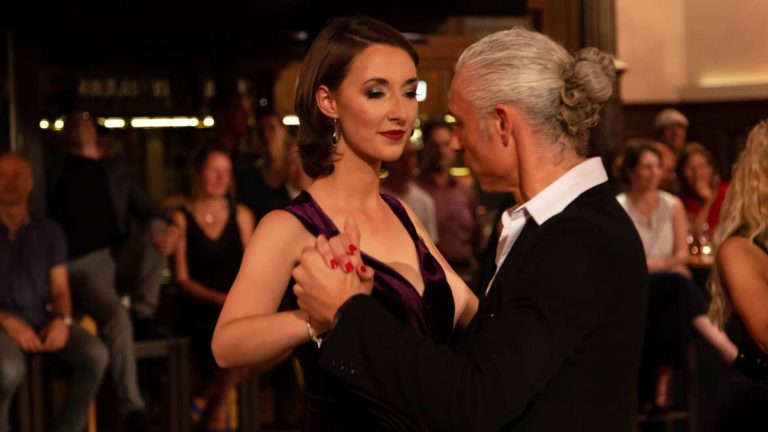
Abrazo: embrace. That’s how every Tango begins—before the first dance steps!
Adorno: decoration; embellishment
Aficionado: enthusiastic (about) – for example about the Tango Argentino
Amague: feint; a deceptive dance step that is dynamically interrupted.
Apilado: The dance partners lean their chests against each other.
B
bailar: to dance
Bailarín/a: dancer
Barrida: “sweep”; sweeping movement; the partner’s foot is shifted with your own foot
Base: short name for paso básico (Tango basic step)
Boleo: >Voleo
C
Cabeceo: from cabeza (head); a traditional technique for inviting dance partners using eye contact and head nods from a greater distance
Calecita: little carousel, turning around a fixed point
caminar: to walk, the way of walking
Candombe: music and dance style, one of the origins of Tango Argentino, coming from the descendants of the black slaves in the Río de la Plata region. The music is of African origin, with a typical rhythm.
Canyengue: Tango music style; originally from the way you play or hit the double bass in tango. Dance style: in a close embrace, the dance steps go sideways in the direction of dance.
Caricia: caress. The foot touches the partner’s leg, >Lustrada
Clase (de Tango): course, instruction session about Tango learn to dance
Códigos: customs and rules at a milonga
Colgada: dance steps and poses caused by tilting; the couple’s feet are connected, they share an axis while the upper bodies move away.
Compás: beat, like the measure in music
Corrida: from correr (to run), a small number of quick dance steps
Corte: cut, a break in the dance
Cortina: curtain. A piece of music that is always played for about a minute between two >Tandas.
cruzado: crossed; (básico cruzado) the crossed system in which man and woman place the same legs (i.e., right or left) at the same time.
Cunita: rocking step
D
Disociación: separating; twisting the upper and lower body in opposite directions
Definición: sequence that completes a figure
E
Eje: axis, controlled body axis; an important basic element of the dance
Enrosque: screwing together of upper and lower body when turning / screwing in the back or front free leg when turning on one leg (enroscar: to screw together).
Entrada: entrance – stepping into the other person’s dance steps >sacada
Espejo: mirror – dance steps in which both partners mirror each other’s movements.

F
Firulete: flourish; umbrella term for embellishments performed with the working leg on the floor to interpret the music or also to attract attention.
G
Gancho: hook; the working leg hooks the partner’s leg. Triggered by contact of the legs.
Giro: turn >Molinete.
L
Lápiz: pencil — with the toe of the working leg, draw an embellishment on the dance floor.
Lustrada: “shoe polisher” — with the inside tension of the working leg, wipe back and forth on the partner’s trouser leg, >Caricia
M
Medialuna: a half-moon-shaped sequence is “drawn” on the floor. After a Sacada, the woman draws a line on the floor.
Mirada: eye contact when inviting to dance
Molinete: a turn in which the couple moves around each other; combination of back Ocho, side step, and forward Ocho.
Milonga: 1. a very rhythm-focused music style (2/4 time). Clear African influences; considered the “mother” of the Tango. The dance steps are different from Tango. 2. Tango dance night; place to dance Tango
Milonguero: (female: Milonguera) a person whose life revolves around dance and the philosophy of Tango—and who often goes to milongas to dance.
Milonguero style: (estilo milonguero) dance style practiced in full dance halls in close embrace. The dance partners have constant upper-body contact, and the dance steps are rather small.
O
Ocho: eight; one of the oldest Tango dance steps, in which an eight is “drawn” on the floor with the feet (combination of >Pivot and step).
Ocho adelante: forward Ocho, ocho atrás: backward Ocho
P
Parada: stop; the man stops the woman with the embrace and foot contact and gives the woman the opportunity to “woo” him with embellishments. This figure takes time within the music.
Pasada: crossing over; the partner’s leg is crossed over using elegant or sophisticated dance steps—passing by the partner / the partner in question.
Paso: step, dance step
Pista: dance floor
Pivote: pivot post; turning in place around your own axis on one foot.
Planeo: flat circling / half-circling of the foot on the floor.
Postura: posture
Practica: practice milonga; an opportunity to practice and experiment
Tango musicians: names you should know
The most famous musicians, composers, and orchestra conductors who shaped Tango. (Click names = link to Wikipedia)


Q
Quebrada: break; the breaking, or surprising bending, of the axis or the line of movement.
R
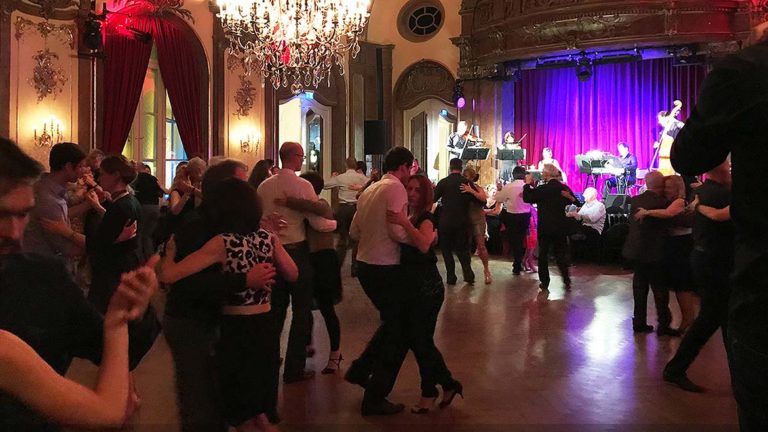
Ronda: the dance round at a milonga (Tango dance event). It is always done counterclockwise in 2 tracks side by side.
Rulo: embellishment in which a circle is drawn on the floor with the toe.
S
Sacada: a man or woman steps into the partner’s lane and thus takes their old place. This can happen without touch (>Entrada), with little touch, or even with strong touch—so that the woman’s leg flies or a >Gancho is created.
Salida: first part of the basic dance step. Going out from standing.
Salto: jump
Saludo: greeting; embellishment—the working leg is bent and lifted.
Sanguchito: also called sandwich or Mordida. The partner’s foot is pinched between your own feet.
Sentada: seated pose of the lady on the man’s body, usually on the knee.
Soltada: dissolving the dance hold. The partners separate briefly and come back together.
More famous musicians from the golden age of Tango


T
Tanda: a piece of music, usually consisting of three or four similar tangos, valses, or milongas. After a Tanda, dancers can casually separate again. Between the Tandas a >Cortina is played.
Traspié: stumbling step; before you shift your weight, the foot is placed extra first, so a kind of stumbling effect is created. These dance steps are used particularly often in the milonga (Milonga traspié).
Tango al revés: shadow position. The leader is behind the follower(s), with his chest against her back.
Tango de salón: Tango style danced in the salon, at the milonga.
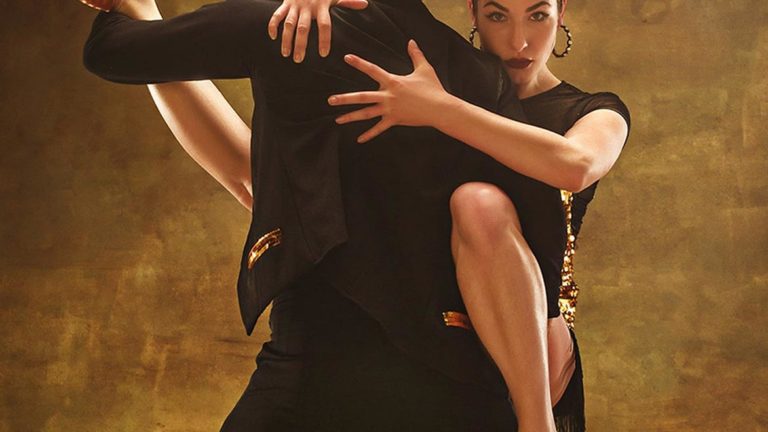
Tango fantasia / escenario: Tango style danced on stage, primarily
audience-oriented. With special impressive sequences, jumps, and acrobatic lift figures.
Tango nuevo / Neotango: Tango style developed from Tango de Salón. It breaks old forms / the embrace and reinterprets known figures and dance steps. It is often played with the axis, so that the dance partners temporarily “lose their balance.”
Tango Nuevo is also the name for the new concert Tango that Astor Piazzolla developed in the previous century—and which is not necessarily suitable for dancing.
V
Vals: Tango in triple time adapted from the Viennese waltz. The fastest, very flowing special form in Tango Argentino.
Volcada: the man briefly tilts the woman out of her axis to put her back upright in a circular movement. In this process her free leg describes a circle that ends with a forward-crossing or backward-crossing. (Forward or backward Volcada.)
Voleo, also Boleo: (pronounced woleo) — comes from the boleadoras. These helped the gauchos catch cattle. Three balls, arranged like a star on a lasso, are thrown and wrap around the animal’s legs. A similar rotating movement is made with the woman’s free leg in tango: the man interrupts her Ocho movement and leads it in the opposite direction.
Voleo bajo: low Voleo
Voleo alto: high Voleo (one of the somewhat “more dangerous” dance steps at a full Milonga!)
Z
Zapatos de Tango: tango shoes—dance shoes specially made for Tango
Learn Spanish
Could this little Tango lexicon be an inspiration to learn the Spanish language?
The language school Living Sprachen offers classes specifically for Spanish from the Río de la Plata, which is spoken in Argentina and Uruguay.
The owner and language teacher Iani Haniotis comes from Montevideo and works in Munich and Nuremberg. Online lessons are also possible! Naturally, Living Sprachen also offers courses or private lessons for European Spanish. In addition, classes can be combined with culture and leisure activities.
Learn Spanish and experience culture: The German-Spanish Society e.V. Munich promotes cultural, economic, scientific, and human relationships between Germany and the Spanish-speaking world.
The Instituto Cervantes is the world’s largest institution for teaching the Spanish language. It also carries out cultural work with films, lectures, or concerts.
***
Title photo: Gabi and Gustavo Gomez, photographed by Lisa Franz. More color photos: Thomas Lackner, Unsplash, Alagalomi
***