


Tango
ART
The art of tango gets a platform here. We would like to introduce painters, illustrators, sculptors, photographers, and writers who have made the Argentine dance, its music, and culture their subject.
“Art is a daughter of freedom.” (Friedrich Schiller)

Karin Lüders
In her series “Tango Heroes,” Karin Lüders portrays influential voices of modern tango. Photorealistic oil painting meets expressive street art from Buenos Aires.

About Tango Art
Tango art means more than just pictures of dancing couples. It shows the passion, melancholy, and beauty of Argentine dance in many forms: in paintings, drawings, sculptures, photos, and texts. It is a cultural phenomenon that has inspired artists worldwide for over a century. In tango art, movement, rhythm, and emotion merge into images that capture the soul of this Argentine cultural heritage.
Painting and Tango
Very early on, artists painted tango. The Uruguayan painter Pedro Figari (1861—1938) showed cheerful Candombe dance scenes and life in the suburbs. In the last century, Emilio Pettoruti (1892—1971) brought tango into modern, abstract art and became known worldwide. Ricardo Carpani (1930—1997) painted monumental, lush, expressive tango figures.
A well-known contemporary painter is Fabián Pérez, born in 1967 near Buenos Aires. His paintings show couples dancing, elegant men and women in clubs or on the street. The mood is romantic, a bit dark, and very emotional.
The painter and tango dancer Guillermo Alió, born in 1950 in San Miguel de Tucumán, also works in Buenos Aires and paints colorful scenes from the tango world. Jorge Luis Alio, born in 1967, studied art and fashion design. For years he worked as a drawing teacher and captures the culture of Buenos Aires through scenes in traditional cafés, bars, and milongas. His works hang in the famous dance hall “La Nacional“.
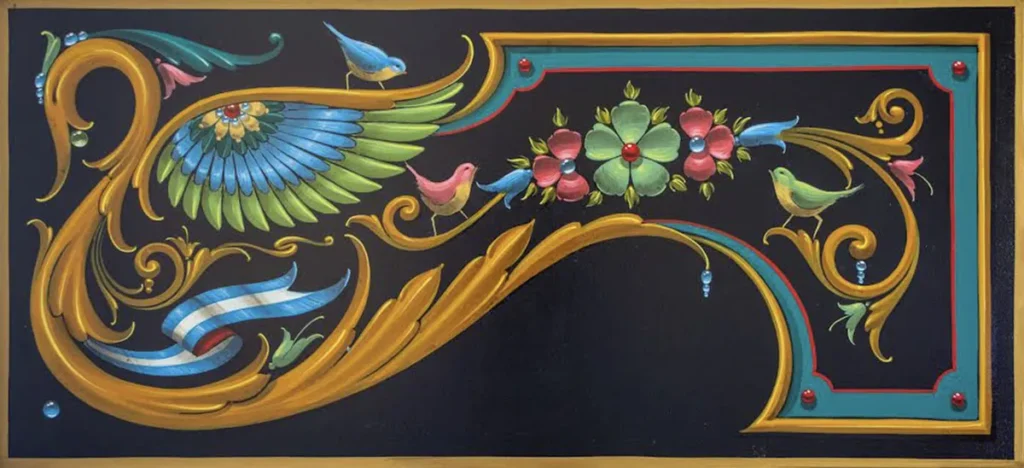
Fileteado Porteño
Fileteado, also called Filete Porteño, is a typical Argentine decorative art from Buenos Aires. It originated at the beginning of the 20th century. At that time, craftsmen (often Italian immigrants) painted horse-drawn carriages, and later trucks and buses, with beautiful, playful patterns. Fileteado is closely linked to tango and life in Buenos Aires. It can still be seen today on signs, in bars, on walls, fabrics, and even as tattoos or body painting. In 2015, it was recognized by UNESCO as an intangible cultural heritage of humanity.
A well-known artist in this field is Jorge Muscia, often called the “Fileteador of Tango.” He combines Fileteado technique with tango motifs, for example, images of Carlos Gardel or other tango greats. He also teaches and has contributed greatly to the continued existence of this art today.
Photography and Sculpture
Photographers capture the special moment of tango: the gaze, the hand on the back, the step in rhythm, the devotion. Argentine photographers like Eduardo Blidner and Guillermo Monteleone, as well as European artists like Markus Schüller or Jens Paritzsch, create impressive images of milongas, intimate dancing couples, or the streets of Buenos Aires.
In sculpture, tango becomes three-dimensional. Artists like Sophie Howard or Leopold Bernhard form sculptures of dancing couples from bronze, ceramics, or other materials. They show the close embrace and the movement of tango. Such works can be seen in exhibitions like “Ars Tango,” and of course, tango dancing couples also appear as comic figures.
Street Art in Buenos Aires
Street art artists also dedicate themselves to tango. Alfredo Segatori paints large murals in Buenos Aires, including scenes from tango dance halls or milongas, dancing couples, and portraits of Carlos Gardel. Marino Santa María has created large paintings and mosaics of Gardel and tango motifs in the Abasto district.
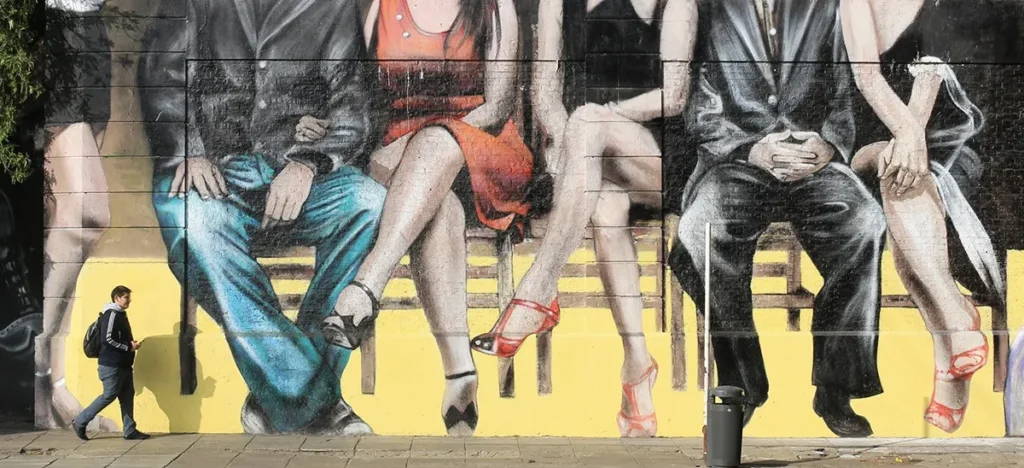
Mural by Alfredo Segatori (Photo © BA Street Art)
Tango Art in Literature
Writers have also been concerned with tango for a long time. Jorge Luis Borges wrote about tango multiple times – in essays, poems, lectures, and even in song lyrics. Various elements of tango also appear repeatedly in the literature of Julio Cortázar. Other well-known authors such as Ernesto Sábato and Leopoldo Marechal have addressed tango in their works.
German authors also contributed to the topic: For example, Wolfram Fleischhauer wrote the well-known novel “Three Minutes with Reality.” Further book recommendations can be found in our blog post “What exactly is Argentine Tango?”
“Galería“ in Tangodanza magazine
If you want to read regularly about tango art, the German magazine Tangodanza has its own section called “Galería.” In almost every issue, the magazine features a tango artist – with texts and images. This keeps tango art present and alive in Germany as well.
Tango art connects people. It shows that tango lives not only on the dance floor but also in studios, galleries, and on the pages of magazines and books. On this website, we want to showcase this and make the diversity of tango art visible.