

The Fashion Guide for Tango Dancers: What should tango fashion be able to do? Beginners in particular often don’t know where to find beautiful dance clothing and what it comes down to. Here you’ll find an overview of the diverse range of dance fashion and popular designers. You can also learn about the origins and history of tango fashion.

What items of dance fashion are there?
Dance clothing – casual or elegant
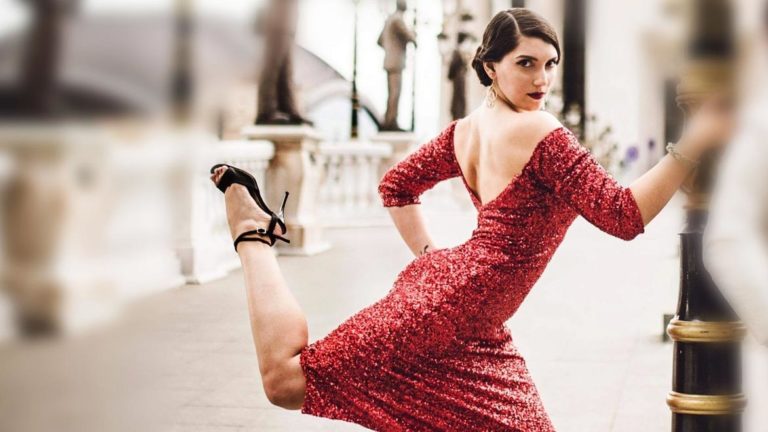
Experienced tango fashion designers know what matters: stretchable, durable, and easy-care materials, lightweight fabrics, and excellent workmanship. The designers create tango fashion for both women and men in all kinds of styles: from elegant evening outfits to simple, comfortable dresses for training, tango skirts, tops, shirts, or tango pants. Plus casual, elegant, or even sexy shapes and cuts that adapt to the movements of the dance and put them in the best light.

Tango shoes – comfortable and durable
Many tangueras and tangueros are looking for the right shoes for the milonga or for lessons. Tango shoes have to do a lot: they should provide secure grip with every step and every turn, be comfortable, and cause no pain or pressure points. They also need to be able to handle a lot, because there are very different dance floors such as parquet, laminate, linoleum, stone tiles, or marble. There are tried-and-tested and dancer-favorite tango shoe brands that combine elegance with the best tradition of craftsmanship. That way, everyone can find their own favorite manufacturer, because not every brand fits every foot!
Accessories – the right add-ons
Alongside tango shoes and tango clothing, of course there are also the right accessories for dancing: beautiful shoe bags, stylish bags for transporting your tango gear, small evening bags and clutches, or practical hand fans for bringing fresh air. Often, it’s the little things that make a dance outfit truly shine!
Fashion designers for tango
There are brands that specialize in the design and production of tango fashion or dance shoes. Tango is not a “mass market”, so it’s usually small workshops that make each piece by hand. Often, the designers are also the manufacturers. Their quality standards are high, and there’s close contact with customers—personal consultation and made-to-measure are common with many brands.
You can find tango fashion and shoe designers at their sales exhibitions at milongas, encuentros, or festivals. Increasingly, they also offer their dresses and tango shoes online. Properly established stores are rare; they’re mainly in larger cities.
Some of these brands that we can personally recommend, we’ll introduce to you here.
Alagalomi – Tango shoes by Claudia Mauriaca
The founder of Alagalomi, Claudia Mauriaca, wanted to design a new, colorful tango shoe line that meets both the need for comfort and the need for stability. Tango Argentino is a dance that embodies sensuality and elegance. But technique and precise movements are also important. That’s why tango shoes are not just accessories, but indispensable tools.

The creation of a new brand
Following these requirements, a young, sexy shoe brand was created. Designer Claudia Mauriaca loves working personally on each shoe model. She coordinates the shapes and colors, selects the leather and the other components. She leaves the final realization to qualified masters of the shoe-making craft. All models are handmade in Rimini, Italy. The end products are technically perfect and at the same time very elegant shoes.
Many options per model
The Alagalomi Shoes team knows that customers are looking for a unique combination of color, originality, and style. They also have special needs when it comes to comfort. Trying them on and feeling comfortable—that’s how it should be! That’s why all models are available in numerous variations. Details such as shape, heel height, or the material of the sole can be chosen in different versions and are made to order individually.
Sensuality meets quality
An increasing number of dancers appreciate the shoe brand from Rimini. They know they’ll find more here than just a perfectly fitting pair of shoes—reliable quality and expertise combined with a sensual Italian style. Exactly the right qualities to support your passion for dance. The different types of soles (leather, suede, or Tunit rubber) are especially popular with show dancers who also want to dance perfectly on difficult floors—for example smooth marble.
Costume Couture Berlin – Tango fashion by Bettina Maria
The fashion of COSTUME COUTURE BERLIN designed by Bettina Maria is pure imagination: theatrical, dramatic, romantic, sensual. Bettina Maria is a German fashion designer who moved from Berlin to San Francisco/USA in the early 1990s, where she began creating her unique fashion. She designed several collections per year, ran her own gallery, and employed up to 10 staff members. In addition, she supplied more than forty high fashion boutiques in the USA with her imaginative “Art To Wear” clothing pieces.

From San Francisco to Buenos Aires
Bettina’s life changed fundamentally when she came into contact with Tango Argentino in San Francisco. Her love for this dance, its music, and its culture led her in 2007 to move to Buenos Aires, where she breathed and lived the tango for three years—quite literally.
The creative energy of the city, the fantastic dancers, as well as the spectacular stage shows inspired Bettina’s creativity. Added to that was her own commitment and her tango dance training. She incorporated all those colorful impressions and emotions into her own art.
Modas de Tango
Soon the first collection emerged under the name “Modas de Tango”. Back then, there were tango costumes for stage shows, but little wearable fashion for visitors at daily milongas. Bettina recognized this—and so success didn’t take long. The transformation was complete: from the high-end fashion Bettina Maria produced in the USA, it became a tango fashion business.
Dressing elegantly for tango is a tribute to its culture for the designer—a sign of respect. However, it doesn’t necessarily have to be traditional or formal. Soft, flowing fabrics can support the expression of the dance even more. Above all, the style, the cut, and also the functionality of the material should do their job.
Imaginative tango fashion
After her long stay in Argentina, Bettina returned to Germany and set up a studio in Berlin. She named her tango line “COSTUME COUTURE BERLIN”.
Still inspired by the style, music, and dance of Tango Argentino, Bettina Maria today designs tango clothing for an international clientele under this label. Her imaginative fashion makes every female dancer feel well dressed and stylish—while always remaining feminine and sensual. Each piece is made individually, with great attention to detail; and of course, made-to-measure is available on request.
Fabric for dancing and dreaming
The designer loves visiting fabric trade fairs on her many trips and purchasing the fabrics in person for her creations. Most come from the American West Coast, especially from San Francisco and Los Angeles, or from Korea, China, Iran, and Japan. But in Berlin she also discovers many astonishing fabrics from Italy, Switzerland, Germany, and Turkey.
Bettina Maria, who also exhibits at the Lady’s Tango Festival, has created her own contemporary style mix. Even though her designs are influenced by tango, they are wonderful as party wear or for other dances such as Salsa, Latin, or Swing.
Tango Leike – Tango shoes made in Italy
Special comfort to wear and elegant design made the handmade shoes of Tango Leike famous. Fernando Eidis, born in Argentina, is the owner of the popular tango shoe brand, which has its production site in Italy.
Tango Leike stands for a collection of classic and fashionable models that make dancers’ hearts beat faster. The sought-after dance shoes are known for their flexible leather sole and the super-comfortable padding under the ball of the foot. They are among the favorite brands of many tango dancers.

Out of love for tango dancing
The Tango Leike brand was founded by Fernando Eidis from Argentina. His love for tango dancing turned him—almost by chance—into the shoe maker and designer he is today. He had already lived in Italy for some time and discovered the tango scene of Milan for himself. One day, a friend running a milonga told him: “We have the milongas for dancing, we have the ladies, but we don’t have any shoes!”
The creation of a new brand
Fernando took that statement to heart. He used his next trip to Buenos Aires intensively to explore all kinds of tango shoes. He found different materials that he combined and began producing prototypes, which he brought to Europe and sold there at milongas. That’s how one of the most important brands for Argentine tango shoes came to be. It was named after Leike, the name of Fernando’s mother.
From Europe to Buenos Aires and back
First, Fernando sold his models in Europe. After the first, very successful period, he took the next logical step: the Tango Leike shop in Buenos Aires was opened. Fernando worked there together with Laura, his older daughter. She ran the shop and the production in Buenos Aires. In addition, she brought fresh energy to the brand. Tango Leike became one of the most popular tango shoe brands in Argentina. But the country’s economic crisis made Fernando return to Europe a little later.
Handmade in Italy
He moved production to Italy and invested in cutting, stamping, and sewing machines. Since then, the shoes have been designed in a traditional craft workshop and made by hand. The special feature: ultra-flexible leather soles combined with supportive cushioning that doesn’t wear down. That ensures hours of dancing fun without tiring out your feet.
Fernando’s Austrian partner, Manuela Dutzler, has supported him since 2014 with design, production, and sales. At Tango Leike, you can also choose different heel heights per model.
Veronica Bond – fashion designer from Munich
The Munich-based Veronica Bond is known for her sophisticated jersey dresses that flatter every figure. Her clothing is incredibly comfortable and pleasant to wear.
Alongside her casual yet spectacular evening fashion, Veronica designed a collection of elegant tango dresses, tango skirts, and tops made from flowing fabrics. She modified the cuts of her evening or daytime dresses specifically for the needs of tango or salsa dancers.

From Munich to New York
At the beginning of her career, Veronica Bond worked in the costume department of the Munich National Theatre before studying fashion design in Paris and then working at Karl Lagerfeld’s studio. Later, she moved to New York and opened the first Veronica Bond shop in the Soho neighborhood, which she ran for many years.
These days, she lives and works again in Munich. Her specialty is refined cuts that slim the figure and put the most different body types in the best light—sexy, but always ladylike.
The exclusive tango collection
The pieces from Veronica Bond’s exclusive collection of tango dresses stand out because they move with every action. The flexible dresses and skirts are either slightly flared or have a slit for enough freedom of movement for the legs. There are no distracting buttons or zippers. Neckholder tops are closed with ties. The fabrics are supple and feel comfortable on the skin. They fall beautifully and are still light enough for hot nights.
Handmade in Germany
All models are sewn in Veronica’s own studio near Munich. When ordering at the Munich flagship store, made-to-measure and your own color preferences are also available. The stretch jersey fabrics used for her dance fashion are wrinkle-free, washable, and preserve their shape, bright colors, and beautiful silky-matte shimmer even after many years.
Transformation artists – the multi-dress
The long-standing bestseller from Veronica’s collection is the “multi-dress”, a model that can be transformed into at least five different dresses depending on how you wrap it! Specifically for dancers, the cut of this “magic dress” was slightly modified: the tango version has a longer skirt at the back and narrower tie straps than the famous original—and it’s knee-length instead of floor-length.
Veronica Bond’s tango dresses are suitable for tango, but also for salsa, swing, or standard dances. These are modern, elegant pieces that attract attention in a pleasant way and can be used in many versatile ways beyond the dance floor.
Paso de Fuego – shoe design from Stuttgart
For many years, Paso de Fuego has been a reliable source for beautiful, solid tango shoes in Germany. Junaid Hameed, the founder and owner of the brand, places great importance on the construction when developing his tango shoes. He designs his women’s shoes to support the tango-typical backward walking—using comfortable padding in the front area of the foot.
The former engineer studied different heel heights intensively and, for his women’s shoe collection, limited the maximum heel height to 8 cm so that the dancer’s knees can always stay flexible.

Versatile shoe shapes for women and men
Alongside classic tango shoes, the lineup for women also includes pretty flat sandals, as well as tango sneakers for training or for women who dance in the lead role. Paso de Fuego women’s shoes are available in heel heights from 2 to 8 cm.
The selection of men’s shoes is just as diverse. It ranges from sneakers to suede shoes and to elegant dandy-style models made from Nappa leather. Even valuable hand-woven leather is used, which provides pleasant airflow for the feet in warm temperatures.
The making of Paso de Fuego
When Junaid Hameed in Stuttgart began, 15 years ago, designing dance shoes, he could only get sparse information about it from shoe manufacturers. Since he himself danced tango, he asked other dancers what they wanted from their shoes. The result: they should be comfortable and you should be able to turn well in them!
Junaid observed the dancers on the dance floor and soon realized that every person has unique feet. Some are narrow, others broader, and some have hallux valgus—making a normal shoe uncomfortable for dancing.
What do tango shoes have to be able to do?
After a while, Junaid was able to define exactly what makes good tango dance shoes. Since he couldn’t find any shoes that met his criteria, he decided to make them himself. He applied his knowledge as an engineer. A new brand was born: Paso de Fuego (Spanish for: “step out of fire”). Making street shoes has a centuries-old tradition, but shoes designed specifically for tango are a relatively new product for a fairly small market.
To dance tango with energy, endurance, and sensuality, it’s especially important for women that the front part of tango shoes is comfortable. They should make it easier to walk backward. In 2008, Junaid Hameed was one of the first shoemakers to introduce padding in the footbed for this purpose.
Handcrafted with know-how
In addition, there are further requirements that the Stuttgart brand wants to meet when manufacturing tango shoes for women and men. That’s why a team of qualified shoemakers with over 20 years of experience is exclusively focused on making dance shoes. This is done carefully by hand—from designing and cutting the leather to sewing and assembling the individual parts. All types of leather and other ingredients come from Europe.
Paso de Fuego shoes are offered at sales events at milongas and festivals, as well as in their own online shop. They can also be tried on directly in the Stuttgart store called “Mi Pasión”. The owner Junaid Hameed is happy to advise customers personally and also makes shoes to measure.
More popular brands
Here you’ll find a small selection of other well-known tango fashion designers or brand manufacturers.
- Tango shoes from Europe:
Madame Pivot, Regina Shoes, Tangolera, Sur, Nueva Época - Tango shoes from Argentina:
Mosh Mosh, Madreselva, Katrinski, Darcos, Comme il Faut, Fabio Shoes - Tanzmode aus Europa:
Tangolace, Modecreator by Anita, Collección Berlin, Mava Lou, Lin Creations, Isabella León, Chique Dancewear, Joan Ferran Collection, The London Tango Boutique - Dance wear from Argentina:
Maria Jazmín, Malvon, Mimi Pinzon
History of Tango Dance Fashion
The term tango refers to a musical genre and a dance style that emerged at the end of the 19th century in Buenos Aires and in Montevideo, the capital of Uruguay. It originated among the lower social classes of the Rio de la Plata region. In its early days, the middle and upper classes embraced tango in places where social classes mixed—for example in brothels.

Back then, the style of tango dancers was considered vulgar. Later, when this dance took off in the United States and Europe, tango culture influenced fashion in the dance halls of Paris, London, Berlin, and New York. Gradually, tango fashion emerged.
Women’s clothing became lighter and looser to adapt to the movements of tango. Flowing silk fabrics in light colors swirled around the body. Even special corsets were made for the dance, allowing greater mobility in the upper body. Men’s clothing was characterized by boots with higher heels, felt hats, and knotted silk neckties. The most famous tango musicians such as Carlos Gardel, who often wore double-breasted suits and combed-back hair, influenced men’s fashion.
Traditional style
After tango lost popularity in the middle of the last century, it slowly returned in the 1980s—and with it, the fashion that initially looked back on the past and more or less copied the style of earlier times. The “immoral” look of the time was first interpreted with black fishnet stockings, red tight dresses with slits, and sling-back pumps in the Flamenco style.
Modern tango fashion today
However, over the past few decades, a contemporary tango fashion has developed that clearly sets itself apart from old clichés. Women’s dresses are made from modern, flexible fabrics available in all conceivable colors and patterns. You show a lot of skin because it’s often hot on the dance floors. A typical Tango Argentino skirt is often longer at the back than at the front so it swings beautifully when turning. Flowing tango pants for women are also popular. There’s suitable clothing for every occasion: for training or casual open-air milongas, elegant styles for a tango evening, and spectacular, imaginative designer pieces for show appearances or stage tango.

Men dress too, depending on the occasion. They enjoy wearing wider pants made from light fabrics that allow plenty of freedom of movement for the legs. As tops, they appreciate nice shirts in black, white, or sometimes even extravagant patterns that also adapt to movement. For training, a casual T-shirt is often fine; for shows and the stage, of course it can be an elegant suit.
And what do you wear underneath?
A special tip: pretty lingerie that fits perfectly with tango fashion is available in the online shop or in the Munich store by Hautnah. For example, well-fitting halterneck or strapless bras—especially popular among dancers who want to feel comfortable wearing airy, figure-hugging tango fashion. Marion Wagner, owner of Hautnah, has lots of experience and offers personal advice!
***
Cover photo: Pixabay. More photos: Laelia Milleri (for Costume Couture Berlin designed by Bettina Maria), Veronica Bond, Alagalomi, Tango Leike, Paso de Fuego, Thomas Lackner.
***