

For the 13th time already, Johana Copes, daughter of the legendary dancer Juan Carlos Copes, is organizing the “Lady’s Tango Festival“ in Buenos Aires in March 2021—this time exclusively online. Her idea: the best tango dancers and teachers give concentrated classes for women for one week; in addition, there are tango shows, live music, tango fashion shows by popular designers, interviews, and information about tango—especially from a female perspective.
“Lady’s Tango Festival” now worldwide
On March 8, International Women’s Day, the “Lady’s Tango Festival Worldwide“ begins. This new edition of the festival, this year in a worldwide format, wants to bring together great dancers, teachers, organizers, fashion designers, DJs, and more from all over the world. In spring 2021 it takes place from March 8–15 online.

It’s a gathering of women from countries all over the world, such as Argentina, Russia, the USA, Italy, Japan, Brazil, Germany, China, Uruguay, Spain, Greece, South Korea, and others. This get-together gives all the tango ladies the chance to get to know one another, exchange experiences, and connect with new people from the tango community.
The festival, which is visited in equal measure by tango fans from all over the world and by local people, also has a German location: the Lady’s Tango Festival in Wiesbaden under the direction of Johana Copes and Natalia Beráscola.

What does the festival program offer?
The festival program includes open discussions, live-recorded classes, dance shows, tributes to outstanding artists of tango dancing, and much more. There will be interviews with DJanes, organizers, singers, writers, and choreographers; in addition, exclusive material from previous festival editions will be shown.
In the March edition, the offer includes 5 live classes directly from the “Copes-Valdez Tango Estudio” in Buenos Aires with Argentine star dancers: Guillermina Quiroga, Ariadna Naveira, Corina Herrera, Virginia Gomez, and Johana Copes. A special class with Mariana Montes will be recorded from her studio in Cagliari/Italy.


Recorded classes stay online for 1 year
As a novelty of this year’s program, the festival presents the “Lady-Revelation 2021“. This is about Agostina Tarchini, who offers a course of her innovative tango dance, blended with other movements. In addition, the festival features more than 20 representatives of tango from different cities and all parts of the world. The special thing: as soon as the classes have been broadcast live, they are uploaded to the ASLAN platform, so you can watch them again and again—and keep access to further training for one year!

How do I take part in the Lady’s Tango Festival?
For the presentation of the general festival, Johana Copes chose the ASLAN platform, where all participants have the opportunity to register, log in, and add themselves to the profile for the Lady’s Tango Festival Worldwide. A one-time entry fee is charged in order to have access to all the material for an entire year until the next festival in March 2022. (The festival is still taking place—as of 2025.)


Interview with fashion designer Bettina Maria about tango and fashion
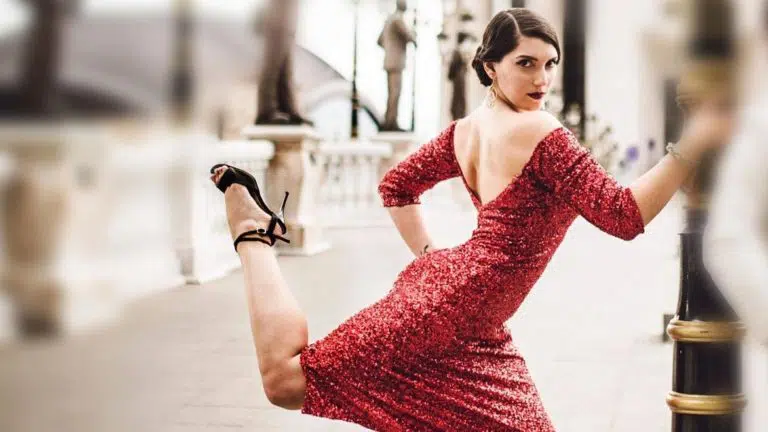
Festival director Johana Copes has long been a fan of German fashion designer Bettina Maria, who lived in Buenos Aires for several years and now designs her exclusive tango fashion in Berlin under the name “Costume Couture Berlin“. On the occasion of the Lady’s Tango Festival in March, we are presenting an exclusive interview with Bettina Maria, conducted with her by Stephan Röhl.
First fashion show at the Lady’s Tango Festival
SR: Bettina, thank you very much for the opportunity to this interview. You showed your early tango fashion collection “Modas de Tango“ in Buenos Aires at one of the first Lady’s Tango Festivals in 2007/2008—back then, in a fantastic fashion show. At the time, you also decided to leave the USA and move to Buenos Aires. In the United States, you became self-employed in 1990 with your private label. Based in San Francisco, you designed luxurious fashion collections, which you showed at some of the most prestigious fashion events like New York Fashion Week. You sold to customers such as Bergdorf Goodman in New York and the famous Golden Door Spa in Southern California, and for a time you employed 10 people.
With that background—what made you change direction, and what was it that brought you to tango back then, so that you moved to Buenos Aires?

Studying and success in San Francisco
Bettina: I certainly didn’t plan it, but I think that if we’re open to life, we follow what moves our heart. That’s what tango meant to me: following my heart. I love tango, I love beauty and fashion, and I love life. I was very fortunate that I, as a German, was able to study at a small couture school in San Francisco.
My expression was always on the theatrical side, because in Germany I first studied theatre costumes. It was also my heart that took me to San Francisco back then—I was already an adventurer. In the creative climate of San Francisco in the 1980s and early 1990s, my unique designs quickly gained a following, and thanks to the connections I made there, I was able to build my business.
The boundaries of the fashion industry
But the fashion industry is also a very tough business that demands an incredible amount of work and constant investments, especially when a company grows quickly. It has its price, and I had to learn as an artist how difficult it is to find a balance between the desire to create something unique while, at the same time, being pushed into production. To be creative, you need space for inventing and creating something new, and it’s an art to keep that balance.


Influence of the show “Tango Argentino”
When I saw “Tango Argentino“ on stage in San Francisco in 1992, I wasn’t only fascinated by the imagination, the dance, and the skill of this early dance company—I was also very inspired by the style of the dresses. It reminded me of what I had originally designed for theatre. Seeing how the fabrics flow together with this wonderful dance movement inspired me much more than designing textile surfaces and working with patterns I already knew, as I had done earlier. It felt so organic—it came alive.
I was thrilled by the creative possibilities that, combined with historical influences from the late 19th century through interesting eras such as the 1920s, 1930s, and 1940s—offered plenty of room for fantasy, just like tango itself—and I saw the opportunity to invent completely unique styles, regardless of show dates and fashion trends. It truly offered me a way to reinvent myself as a designer and create an international fantasy collection that would appeal to women from the most diverse backgrounds, regardless of culture.
A new direction in tango culture
Basically, we artists in tango kept creating our own culture over and over again. It was new—we had the beginnings of tango, the history—but then there was a big pause. Only in 1992 did the first dancers start touring again, when the shows “Tango Argentino“ and “Forever Tango“ became known and were seen in Europe and the USA. So only a few years later, a revival began, bringing forward the next generation—and we became international.
The same happened in music. All these different musicians referred back to the origin of tango, but brought their own cultural influences and new interpretations. (A wonderful example is the Beltango Quinteto from Serbia.) We all started influencing one another—that was such an exciting time for tango and for every artist who worked professionally in tango! It felt unbelievably alive in those days, sensing the historical past of early tango history before the big boom came—later even called the “tango industry”. It was the time when we were still finding the little shoe shops on the Calle Suipacha to buy a pair of hand-crafted original Argentine tango shoes.

United in creative movement
SR: What did tango mean to you personally?
Bettina: When I finally attended my first dance class in 1998, it moved my emotional center—and in those first hours I was overwhelmed by two feelings: bliss and tears. It was because of the deep connection tango offered through the embrace, and the experience of moving in unity, in synchrony. Being united—together—in creative movement with another person, in community with others, on the dance floor, was exceptional. Nowhere else could you have that experience.
Up to that point, my reality as an artist had meant being alone in my studio and designing at my table with my sewing machine. What I missed was community. In tango, I experienced for the first time—maybe similar to musicians in an orchestra—what it’s like to create something together in synchrony. The flow you feel when you move intuitively to the music, in harmony with another person, constantly refining and expanding your technical abilities—that is truly a unique experience.
The first tango fashion for milongas
That was the time when I went to classes and practicas in San Francisco four to five times a week, and soon my studio was filled with tango music. I started thinking about tango, feeling it, breathing it, and designing for tango. The other dancers noticed that I was wearing my own dresses and asked where I got them, because at the time nobody designed tango fashion for milongas—the social dance—not just for the stage. As a businesswoman, I recognized a huge opportunity.

The time between the old and the new world
When I went to Buenos Aires for the first time in 2000, I was very lucky to still experience the early days before the big tango tourism boom—it was so special to be there in the afternoon at La Confiteria Ideal, and to discover small, hidden, long-established milongas that were visited only by Argentine dancers. It was a fantastic experience of a moment in time between the old and a new world.
The Buenos Aires adventure
In those days, I started training with Rodolfo Dinzel in his small Estudio Dinzel on the Calle Jufré in Villa Crespo. What a great adventure of experimenting with intimacy, with creativity! Finally, 6 years later I moved to Argentina and literally immersed myself in tango around the clock for three years. It was an enormous healing from a life I had lived in a treadmill, chasing one deadline after another and trying to meet the demands of a fashion business.
It was also the right moment to recognize that the creation of tango fashion would allow me to live in Buenos Aires and train tango professionally with the best teachers. That was a great privilege and one of the most adventurous times of my life!
Freedom in tango
SR: Looking back on the 20 years of dancing—what did tango essentially teach you?
Bettina: Tango opened me up to play again and to discover many things. To be present in the moment, to learn to truly listen to music, and to cultivate perception and hearing. It taught me to express emotions through my body in connection with another person, while improvising.
From my point of view, that was what was special about the Dinzel method. It meant freedom. Freedom to be, freedom of expression of creativity, freedom to enjoy simplicity—not for profit or money, which had become very painful in the design business—having to press my creativity into a product in order to sell it and survive. I remember that Rodolfo often talked about freedom. Tango has a certain structure, a certain code, and a few steps, but within that structure you are free to improvise, reinvent, and discover.
Open to surprises
Tango also teaches us a lot about relationships, about harmony and respect. It teaches us to listen, to perceive physicality. It also teaches us to become still, to allow pauses, to wait for the partner. It also teaches us to be open to surprises—and that means becoming childlike again. I believe that’s why tango dancers tend to be happy when they can dance. It fulfills a human need.
***
Fashion by Costume Couture Berlin
Designed by Bettina Maria
Requests by email: costumecoutureberlin@gmail.com
Dance shows from the Lady’s Tango Festival on YouTube
To get a taste of the festival atmosphere and to watch performances by the star dancers, we recommend the video playlist on our YouTube channel: “Lady’s Tango Festival“, filmed in Buenos Aires in 2019 and 2020. They dance: Johana Copes, Ariadna Naveira, Milena Plebs, Guillermina Quiroga, Maria Nieves, Fernanda Ghi, Lorena Ermocida, Aurora Lubiz, and Pepa Palazon. Our channel also features 3 beautiful videos of Ariadna Naveira that were filmed at the 2019 Munich tango festival.

***
Als Unterkunft in der Stadt empfehlen wir die beliebten Tangohotels, zum Beispiel das Apassionata Tango Hotel, das Luna Lila oder das Mariposita de San Telmo.
***
Johana Copes on Facebook
Johana Copes Email: ladystango@gmail.com
***
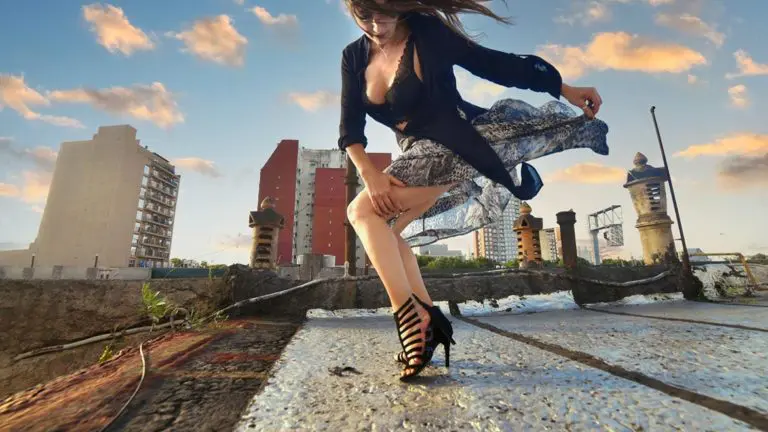
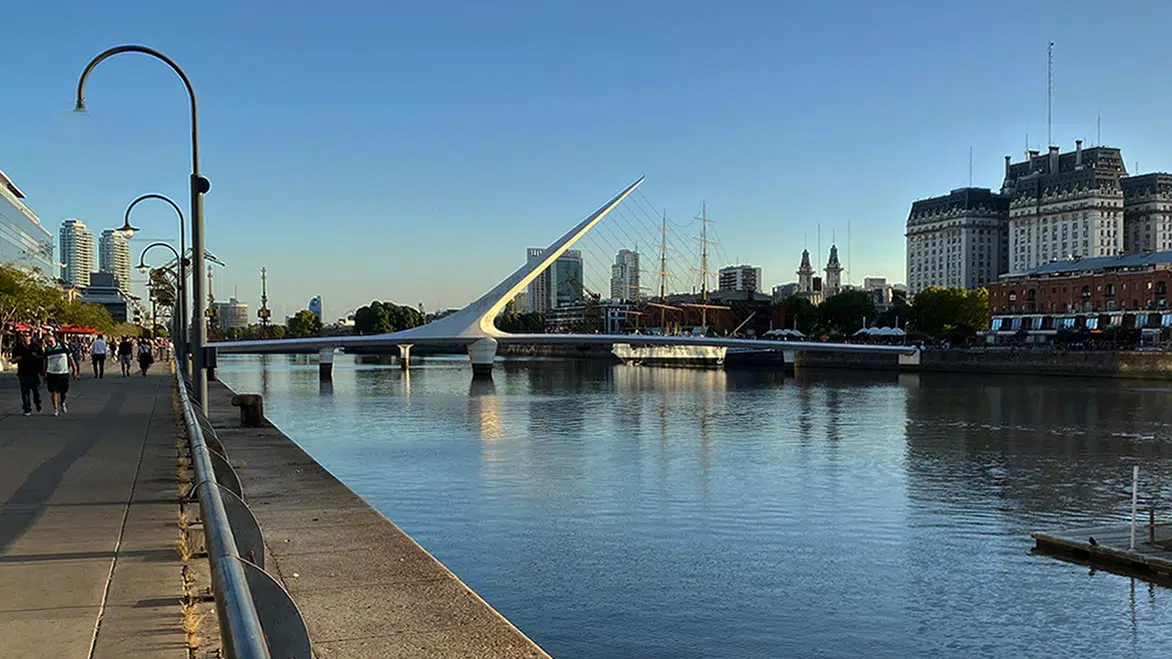
Cover photo “Puente de La Mujer“ (Bridge of the Woman) in Puerto Madero/Buenos Aires, photo “Fashion show” and videos by Karin Lüders. Photos by Costume Couture Berlin: Laelia Milleri.
***