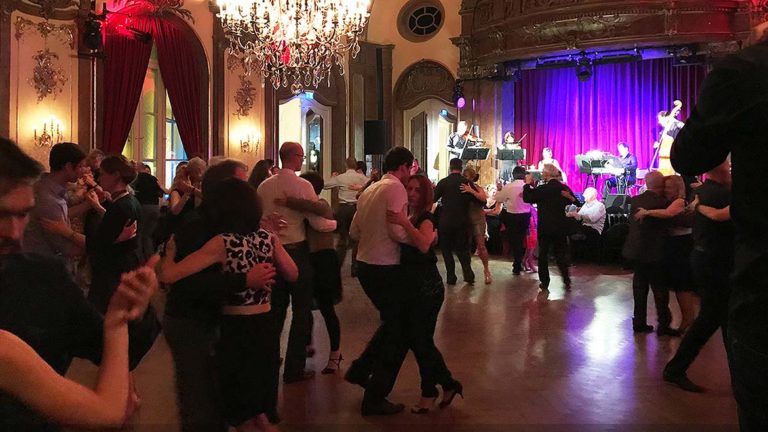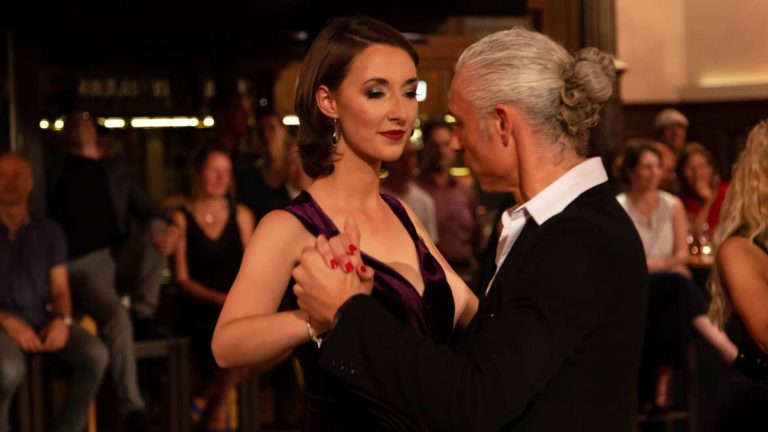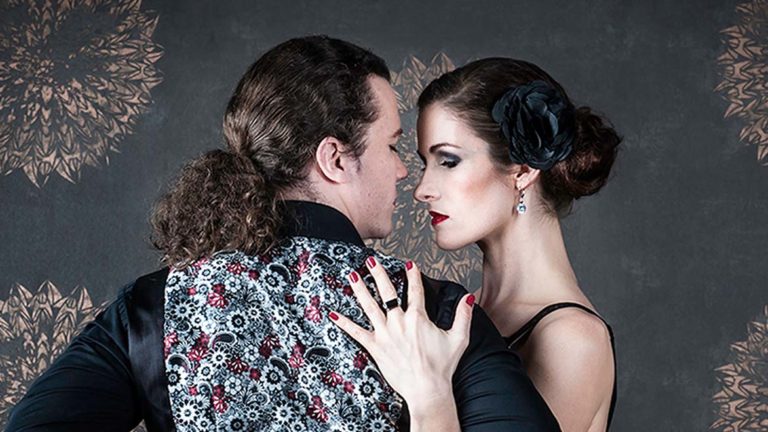



Since the end of the 18th century, the dazzling Vienna balls have been directly connected with the worldwide spread of the Vienna waltz. In the Austrian capital, people have kept the tradition of these dance events alive to this day, the best-known being the Vienna Opera Ball. In the meantime, it’s not just rock ’n’ roll or salsa there, but since 2017, Argentine tango has also been included among the social dances. What common ground does a Vienna ball share with a tango event in Buenos Aires?
After an original article by S. Elefante, M. V. Arenillas, S. Jovicic and M. Elefante
Time travel to the past and back
Did a ball tradition similar to the one in Vienna develop in Buenos Aires over the course of the 19th century? We set off on a journey into the past to discover the similarities and differences between these historic events and compare them with the typical dance events for Argentine tango— the milongas in Buenos Aires—then and now.

Historical sources show that not only in the capital of Buenos Aires, but also in other regions of Argentina, people were organizing elegant ball nights already in the 19th century. Evidence of this can be found, for example, in the text of the tango vals „Vals del 18“, written by Horacio Ferrer and Astor Piazzolla in 1981.
This piece of music is a remembrance of past times—more specifically, of the year 1918. As the lyricist, Horacio Ferrer recalls his aunt with great affection: at that time she attended these events and had the opportunity to dance to different rhythms such as the waltz, foxtrot, and also tango.
„Vals del 18“
Lyrics: Horacio Ferrer, Music: Astor Piazzolla
Turn your waltz of the year 1918,
do you still remember? I wrote it for you with love
as a keepsake of you. When you illuminated
life in those times, when it was better—
dressed in bright colors, with fringes to the point of blushing.
…
Turn your waltz, please let me put on my tailcoat,
let’s go dance together.
…
Your heart combs itself à la Garçonne
and your modesty wears a corset.
And a poet wraps your beauty around the waist:
that sweet thief who bound you to his life,
the one who is no more.
…
Turn your waltz, turn around so it turns,
and its rhythm carries garters
and even takes snuff.
In your eyes, joy shines
since the peace was signed, and a major prize—
you dance foxtrot and sing along.
…
(Excerpts from the original text, translated from Spanish)
Grand balls in Vienna and in Buenos Aires
With this text by Horacio Ferrer as inspiration, and drawing on historical documents, we bring the balls in Buenos Aires back to life. In the Argentine metropolis, they were already held in 1877, as a notice for a ball at the opera shows. Evidently, such dance events were still popular in the 1910s, as you can see in Ferrer’s “Vals del 18”.
We don’t just compare these events with the traditional balls in Vienna, but also with the milongas of different eras.
After the era of the Congress of Vienna in 1815, the Austrian capital became known for its magnificent dance balls. Every year, more than four hundred balls take place here—often in the city’s historic buildings, such as the Hofburg or the Vienna State Opera. The Vienna Opera Ball is world-famous; the ball of the Vienna Philharmonic is considered especially exclusive.
Although Vienna’s balls are offered year-round these days, the start of the traditional ball season coincides with the beginning of the carnival on November 11. The Vienna ball season ends with Shrove Tuesday in February.

What role does carnival play?
No doubt, dance events also took place in Buenos Aires during carnival season. An advertisement for the 1877 opera ball reveals the dates “January 20 and 21.”
A poster from the 1930s announces six big balls (“6 grandes bailes”) that took place during carnival season at the Teatro Colón in Rosario de Santa Fe. Among others, the tango orchestras Firpo and Canaro appeared there. This shows that large ball nights were organized not only in Argentina’s capital, but also in other cities around the country.
In the 1930s, dance festivals at the “Broadway Theatre” on Calle Corrientes in Buenos Aires were announced as masked balls. This suggests that these events also took place during carnival season.

Balls featuring Troilo, Caló and Di Sarli 
Tango couple around 1900 
Advertisement for 6 Grandes Bailes – masquerade balls, 1930s
An advertisement from the 1940s explicitly promotes a carnival ball at the “Luna Park” in Buenos Aires, which served as a venue for concerts and sporting events, but also as a dance hall. It is well known that many major dance events were hosted there in the 1950s as well.
The announcement of an event with the Tango Orchestra of Aníbal Troilo shows that in Argentina’s capital, ball season was still underway during carnival time in 1963.
Apart from that, however, there are no indications of whether these events in Argentina took place only during carnival season or regularly throughout the year. We also don’t know exactly whether a ball tradition existed even before 1877.

Where did Argentine tango originate?
On the other hand, the origins of Argentine tango and the milongas can be traced back to the second half of the 19th century in the Río de la Plata region—above all in the city triangle of Buenos Aires, Rosario and Montevideo/Uruguay.
Back then, Argentine tango spread rapidly in Europe and reached Europe’s main capitals in the first decade of the 20th century. Vienna saw a sudden rise in events that embraced this new dance style. Whether in a simple dance hall or in a Baroque ballroom—everywhere you could hear the sounds of the new rhythm. To this day, there are regular and numerous milongas in Buenos Aires, just as there are in the waltz city.
Party halls: Hofburg, Vienna State Opera and Teatro Colón
Above all during Vienna’s ball season, balls are still regarded as outstanding events and therefore usually take place in the city’s most beautiful historic venues. Very prestigious are the events held at the Hofburg and the City Hall (Rathaus). More than a thousand guests attend such a ball and dance there until the early morning hours. Of course, the highlight of the ball season is the famous Vienna Opera Ball.

The festive atmosphere of Vienna’s dance events seems to show parallels with those in Buenos Aires. The text of „Vals del 18“ shows that men had the option of wearing a tailcoat. Based on the clothing, we can therefore assume that the ball nights in Buenos Aires were also organized in elegant party halls.
This impression is supported by documents showing that Argentina’s capital city’s dance festivals were held both in the magnificent Opera House, the Teatro Colón, and in renowned theaters on Calle Corrientes.
Milongas in Buenos Aires: tango for everyone
In contrast, the typical tango dance events of Argentina—the milongas—could be found in places accessible to everyone. To this day, milongas are organized in everyday venues such as dance schools, cafés or restaurants. Only on certain occasions—for example during a tango festival—do they take place in special event locations such as historic party halls.
What social background do ball-goers and milonga visitors have?
In Austria’s capital, guests at a ball were typically connected to one another through their membership in a shared professional group. Consequently, they often belonged to the same social class. From the early 19th century onward, various occupational groups celebrated their respective activities by organizing dance festivals—for example, the sugar baker’s ball or the coffee roaster’s ball. This tradition has been preserved to this day. Nowadays, it’s not only professional groups that host dance balls, but also groups of people who share a common private interest.
Furthermore, in the context of these events, young women from the highest social circles—the debutantes—were traditionally introduced to society dressed in white. This custom is practiced today only to a limited extent.
In Buenos Aires, however, nothing suggests that the dance festivals were connected with specific professional groups. It is also not known whether debutantes appeared at a ball in order to be introduced to society.

The city’s milongas also have no connection to specific professional groups. These are events whose primary purpose is to dance Argentine tango, vals criollo and milonga (here: music style). In earlier times, however, the milongas in Buenos Aires served immigrants not only for fun, but also as a meeting place for potential marriage partners. Up to the present day, milongas have retained the popular character of casual dance events, regardless of whether a particular occasion is being celebrated.
Music styles of Vienna’s balls
Vienna’s balls can also be seen as an appreciation of the arts of music and dance in general. In this sense, over the years the range of traditional social dances has been expanded with newer dance styles. Today, you can find orchestras and DJs playing all kinds of music styles—from the Vienna waltz, foxtrot, and swing, to salsa and bachata—to satisfy every ball-goer’s taste in music. As a midnight interlude, a quadrille is often offered.
Although Argentine tango became widespread in Austria’s capital in the 1920s, there is no evidence that a milonga took place as part of one of the big ball nights.
On the other hand, there is evidence that Argentine tango was explicitly excluded in 1914 from the 23rd Vienna City Ball during a meeting of the dance committee. It was considered too “shady.” This judgment was maintained for a long time until—since the beginning of the 21st century—tango performances were sporadically seen again at some balls.

Video: Professional show—Chiara Greco and Martin Acosta at Vienna’s Hofburg
Since 2017: Argentine tango in Vienna’s ball program
For the first time in 2017, Argentine tango was represented with a milonga at the Ball of the Technical University of Vienna in the Hofburg. Thanks to how well guests took to it, this was continued in 2018, 2019 and 2020.
In 2018, the Concordia Ball in the City Hall (Rathaus) picked up on this development with a themed evening for Argentine tango. Since 2019, the Vienna Ball of Sciences has also offered an explicit room reserved for Argentine tango.
Music styles at the balls of Buenos Aires
Also in Argentina’s capital, different music styles were included in the ball program. Thus Horacio Ferrer writes in the text of the “Vals del 18”: “Turn your waltz” and “You dance foxtrot and sing along.”
In celebration of the ball nights at the opera house in 1877, people danced to a variety of rhythms: polka, habanera, mazurka, waltz, quadrille, etc. The poster shows that Argentine tango was represented, just like foxtrot, rumba and vals. However, it isn’t clear whether on this occasion the Vienna waltz or the Vals criollo was played.
But the assumption is close at hand that the Lomuto Orchestra played Argentine tango, milonga and vals criollo, while the Ivan Weishaus Orchestra presented the Vienna waltz. At the announced ball, people danced to tango, jazz and swing, while at another ball the tango was accompanied by Hawaiian serenades alongside jazz.
At a “Spanish” dance event, it seems that half Argentine tango and half Paso Doble was played. However, there were also dance balls, similar to milongas, at which the tango orchestras Firpo and Canaro were invited. Understandably, at these you heard only Argentine tango, vals criollo and milonga.
There are also indications on the advertisement for a ball of the “Cine Argentino” that only Argentine tango was on the program, since the poster only announced the Tango Orchestras Zerrillo and Brujos.

Advertisement for Teatro Colón Rosario, 1917 
Poster for Teatro San Martin 
Tango book by Horacio Ferrer, 1960 
Advertisement for Troilo and jazz, 1963
Music at the milongas in Buenos Aires
Culturally and historically, the milongas in Buenos Aires were places where people danced to a variety of music styles. Although the tango rhythm was undoubtedly dominant, you could always dance to other rhythms too. In the past, these included jazz, Caribbean dances, rock ‘n’ roll and Argentine folklore. According to Eduardo Arquimbau, one of the most important tango dancers and teachers of the last century, at the milongas of the 1950s, the share of other music styles reached up to 50 percent.
In the suburbs of Buenos Aires and in the interior of the country, milongas with a high percentage of other music styles still exist today. Internationally, however, the model of some milongas located in the city center of Buenos Aires has prevailed: these are where only Argentine tango, vals criollo and milonga are danced.
The invitation—by dance card or cabeceo?
In the past, ladies could use a dance card—a Carnet de bal—both at a ball in Vienna and at one in Buenos Aires. It was a small booklet in which the different dances of the evening were listed. The respective dance partner could sign up there. In Vienna, this custom is no longer common, and the gentleman asks the lady to dance with a polite question.

Video: Tango dancing by students, TU Vienna ball at the Hofburg
At tango events in Buenos Aires, however, it is tradition that the gentleman invites the lady to dance with the cabeceo—a slight movement of the head. If the lady agrees, she confirms the invitation as well with a nod, and the dancer then approaches her and they begin to dance. At milongas it is not customary to invite a lady who is accompanied, unless she makes it clear that she wants to dance not only with her partner.
Therefore, at traditional milongas, men and women usually sit facing each other in order to make the dance invitation easier with the cabeceo. Couples who want to spend the evening together, by contrast, sit down at tables located on the third side of the dance floor.
However, this kind of dance invitation seems relatively modern. From old photographic material it appears that around 1900, the men stood in the middle of the hall and called on the women from there. Young women stood along the walls of the hall, while their mothers and older sisters sat.
Today, you can also find milongas where this traditional style of inviting to dance is no longer followed. It even happens that a female dancer takes the initiative and invites a male dancer. The roles of men and women in Argentine tango are no longer fixed, but interchangeable. It’s not uncommon to see women take the leading role—and vice versa.
Dance attire
In Vienna, strict dress codes are also part of the long ball tradition that guests are expected to follow. The ball committee reserves the right to deny admission to visitors with inappropriate clothing. At the most elegant balls, such as the Opera Ball, ladies are required to wear an evening gown at least ankle-length, while the model and color are up to the dancer. Gentlemen, on the other hand, must wear a tailcoat or a tuxedo.

There are no sources on whether ball-goers in Buenos Aires had to follow a fixed dress code. However, we can assume that the clothing was elegant and appropriate for the occasion. As evidence that the dancers were dressed stylishly, we use Ferrer’s waltz text, which speaks of garters, tailcoats and the woman’s dazzling attire.
At the beginning and middle of the last century, it was common for the guests of milongas in Buenos Aires to wear more elegant clothing as well. However, there was no dress rule stating that ladies had to wear a long dress. The reason for this may also have been that this allowed dancers to continue performing typical Argentine tango steps such as boleos and sacadas.
However, dance attire in relation to milongas also depended on the general context. It was customary for the gentleman to wear a tailcoat or tuxedo on the occasion of an important event—at least until the 1930s. At an everyday milonga, the dress code was less formal. The men wore a suit jacket and a shirt, which at the time was quite casual.
The current milongas do not prescribe any specific dress code. The dance fashion can vary from elegant to casual and sometimes also depends on the organizer’s requirements. At tango festivals, more festive dance clothing is often expected, while casual leisure clothing is acceptable at the weekly milongas. Anyone looking for appropriate fashion or dance shoes will find a range of proven designers who specialize in tango.

The closing ceremony: Vienna balls and milongas
Whether it’s the end of a Vienna ball or the end of a milonga, both follow a similar ritual: at the end of the evening, a symbolic piece of music is always played. In Vienna, people end the night with the famous waltz “An der schönen blauen Donau” by Johann Strauss, while milongas often like to end with the piece “La Cumparsita,” which can be played in various orchestral versions.
However, we don’t know how the balls in Buenos Aires ended and whether there was a ritual for that as well. Looking at the different promotional posters, we see that waltz orchestras—and even Argentine tango orchestras—were not always represented in the music program for the evening.

Title: waltz “The Blue Danube” 
Dance card featuring waltz and tango 
Title: tango “La Cumparsita”
Conclusion
There is a wealth of information about Vienna’s balls—undoubtedly because the tradition there is still very much alive. By contrast, the indications for such events in Argentina are more scarce, even though many historical details about tango in Buenos Aires are known.
However, we note that the Vienna balls and those from Buenos Aires share certain characteristics—such as holding the dance events in the same time of year and in magnificent party halls, dancing to a variety of music styles, and following an elegant dress code.
The comparison of the balls with the early milongas of Buenos Aires, on the other hand, shows significant differences. These can be traced in part to the different social background of the guests: the aristocracy and upper class were present at the balls, while immigrants, the middle class and the working class visited the milongas.
In the meantime, that has changed. Regardless of their social background, origins and age, all dancers who would like to dance tango go to milongas—and do so all over the world.
The connecting element of milongas, as well as the ball nights of 1815, 1900 or today, is undoubtedly the joy of dancing—whether it’s waltz in Vienna or tango in Buenos Aires. So let’s all take up Ferrer’s message: “Let’s go dance together,” because the most important thing is to spend a pleasant evening and enjoy ourselves on the dance floor!
***
“Balls and milongas in Vienna and Buenos Aires: analysis and comparison” by the authors S. Elefante, M. V. Arenillas, S. Jovicic and M. Elefante
Amartango, tango school by Victoria Arenillas (co-author)
Reading tip: Otto Eder, „Tango!!! – Ein Fremdling in Wien“, published by Ralf Sartori in the Allitera-Verlag.
***